Penal Substitution:

A Reductionist Twist on the Gospel
Few doctrines have dominated Western Protestant theology like penal substitutionary atonement (PSA). According to this model, God’s justice requires punishment for sin, and Jesus satisfies that justice by bearing the penalty in our place. On the surface, this seems biblical: Jesus died for us (ὑπὲρ ἡμῶν, “on behalf of us”). Yet careful reading raises critical questions: Does Scripture depict God as demanding penal satisfaction? Is God’s wrath primarily retributive, or covenantal? Does redemption through a “price” necessarily mean legal penalty?
Scholars from diverse traditions have long questioned PSA’s adequacy. N. T. Wright (2016) emphasizes that the New Testament portrays the cross as God’s covenantal action to restore creation, not a transaction satisfying legal wrath. James D. G. Dunn (1998) argues that Paul consistently frames salvation in relational and covenantal terms, while John Murray’s classic defense (1955) represents the Reformed legalistic overlay that dominates modern Protestant thought.
God’s Wrath: Covenant Context, Not Penal Rage
Romans 1:18–32 describes the wrath of God (ὀργή, “divine anger or judgment”) as being revealed from heaven. But Paul immediately clarifies that this wrath is expressed through God giving humans over to the consequences of idolatry (Rom 1:24, 26, 28). Here, wrath is covenantal, not retributive. Scholars like R. W. L. Moberly (2013) note that the language of “giving over” aligns with Israelite covenantal discipline, not a divine penal system.
In Romans 3:21–26, Paul presents Christ as a hilastērion (ἱλαστήριον, “mercy seat”). This term literally refers to the cover of the Ark of the Covenant (Exodus 25:17–22), where God’s presence met Israel and sin was ritually atoned for. It is cultic and covenantal, not judicial. Paul emphasizes God’s faithfulness to covenant promises (δικαιοσύνη), not satisfaction of wrath. Wright (2016) and Harrington (1990) note that hilastērion evokes atonement space within covenantal worship rather than courtroom logic.
Isaiah 53: Healing, Not Penal Payment
Isaiah 53:5 states: “He was pierced for our transgressions… by his wounds we are healed.” The Hebrew term מוּסָר(musar) often translated “chastisement” conveys discipline or corrective suffering, not penal punishment. The Servant suffers representatively for Israel, emphasizing healing and restoration, not satisfaction of divine wrath. Moberly (2013) highlights that the text portrays God as acting for the restoration of the covenant community, not as a judge exacting penalty.
Galatians 3:13 similarly notes that “Christ redeemed us from the curse of the law by becoming a curse for us.” Here, κατάρα (katara, “curse”) refers to covenantal alienation, not legal punishment. Christ enters into the consequences of the covenant to restore inclusion, especially for Gentiles. Dunn (1998) emphasizes that this demonstrates solidarity with Israel’s condition, not penal substitution.
God Is Not a Pagan God
PSA often mirrors pagan sacrificial logic: an angry deity requiring appeasement. Scripture subverts this. God provides the sacrifice (Gen 22:8, 13), desires mercy over ritual sacrifice (Hos 6:6), and forgives freely (Ps 103:10–12). Wright (2016) stresses that the cross is God’s self-initiative to restore humanity, not humanity’s attempt to pacify divine wrath.
Ransom language clarifies this further. Mark 10:45 describes Jesus giving his life as a λύτρον (lytron, “ransom” or “liberation price”). In context, this evokes liberation from slavery, not the payment of a penalty to God. Exodus imagery supports this: blood is provided to free captives, not to satisfy wrath (Dunn, 1998). Salvation here is deliverance, not legal transaction.
The Multi-Faceted Biblical Vision of Salvation
The New Testament portrays salvation in diverse, complementary ways:
Reconciliation: 2 Corinthians 5:18–19 emphasizes that God reconciles the world to Himself. The focus is relational restoration, not legal satisfaction.
Forgiveness: Colossians 2:13–14 highlights that sin debt is canceled, not transferred, emphasizing grace.
Victory/Liberation: Colossians 2:15 presents Christ’s triumph over powers, portraying the cross as cosmic liberation.
Participation/Union: Romans 6:3–5 emphasizes believers’ union with Christ in death and resurrection, showing salvation as transformative.
Covenant Faithfulness: Romans 3:21–26 frames God’s justice as faithfulness to covenant promises.
Healing/Restoration: 1 Peter 2:24 presents the cross as overcoming sin and disease, not penalty, highlighting a restorative framework.
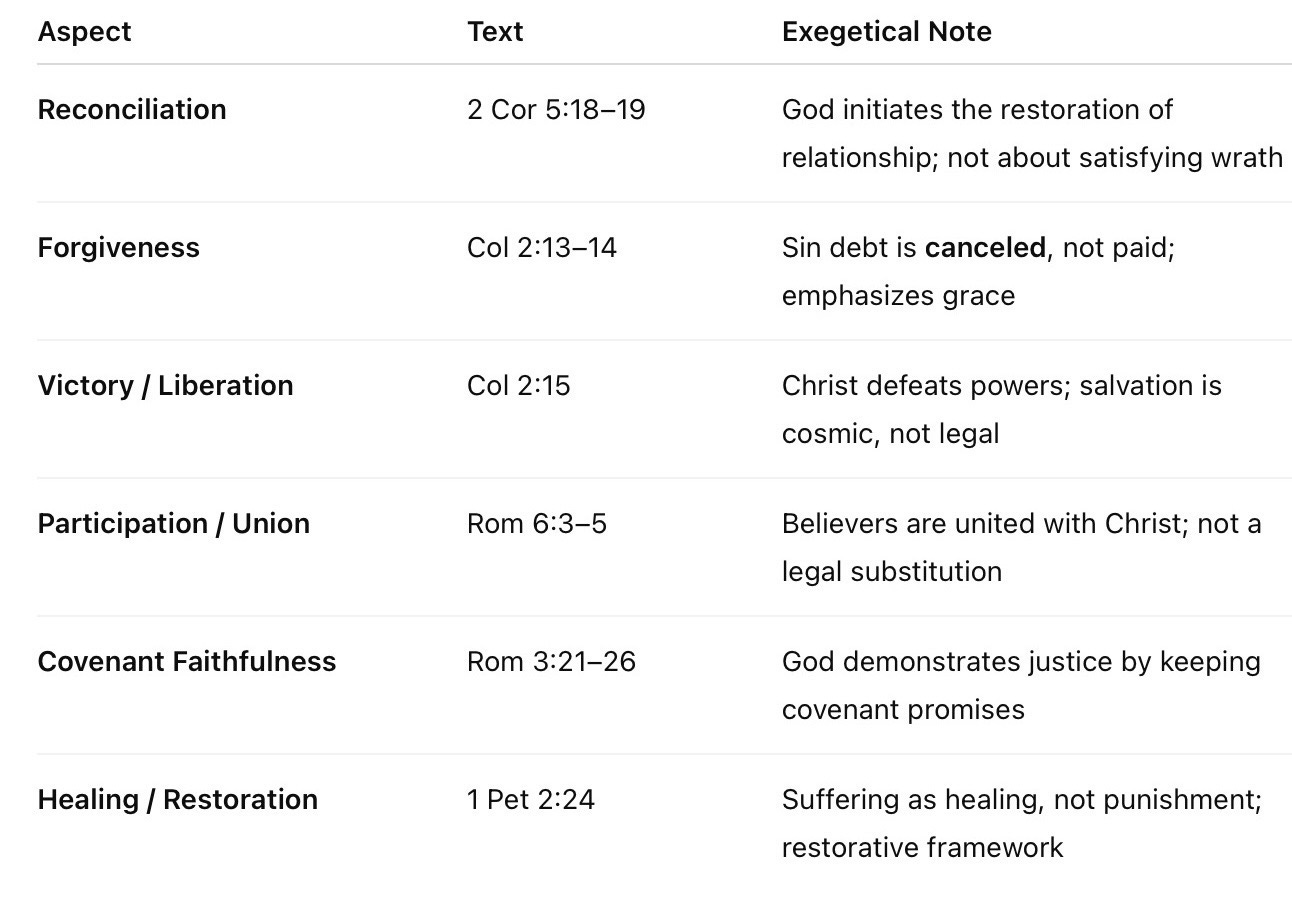
These descriptions show that salvation is far more relational, restorative, and cosmic than the narrow legalism of PSA.
Why Penal Substitution Misrepresents the Cross
PSA misrepresents the cross in four key ways. First, it misdefines wrath, treating it as retributive anger needing satisfaction. Second, it over-imposes legal frameworks, reading courtroom categories into temple and covenant texts. Third, it risks dividing the Trinity, portraying the Father as angry and the Son as appeasing, contrary to the New Testament’s portrayal of God acting in Christ. Fourth, and most critically, PSA reduces the gospel, sidelining liberation, reconciliation, participation, and cosmic victory in favor of a narrow focus on punishment.
Jesus’ death is undoubtedly substitutionary, but the penal framework is a later, reductionist overlay, not the core biblical message. The cross is better understood as God in Christ overcoming sin, death, and alienation to bring humanity back into covenant life. The biblical vision emphasizes reconciliation, covenant faithfulness, liberation from powers, participation in Christ, and healing and restoration. Modern theology must not discard substitution, but reintegrate it into the full biblical vision of salvation, recovering the richness, relational depth, and cosmic scope of the gospel.
Clarifying Substitutionary Atonement Beyond Penal Models
When Scripture speaks of Jesus as substitutionary (ὑπὲρ ἡμῶν), it does not automatically mean he bore punishment in our place. Instead, substitution refers to representative, covenantal, and relational participation. Jesus stands in our position, not to satisfy God’s anger, but to enter fully into the human condition of sin, alienation, and vulnerability, bearing the consequences of our brokenness so that God can restore us. He represents humanity before God, Israel before the nations, and the covenant people before the covenant God. This substitution is redemptive, restorative, and inclusive, emphasizing solidarity rather than punishment. In this sense, Jesus’ death functions as a bridge: he takes our place in the consequences of sin—exile, separation, and the power of death—so that we may be reconciled, forgiven, healed, and incorporated into the covenantal community of God. Scholars like N. T. Wright (2016) and Dunn (1998) stress that this view preserves the substitutionary reality of the cross without reducing it to a legalistic penal transaction, showing that salvation is about relationship, restoration, and cosmic renewal rather than appeasing divine wrath.
Mini Greek/Hebrew Glossary for Readers
ὑπὲρ ἡμῶν (hyper hēmōn) – “on behalf of us”; substitutionary sense.
ὀργή (orgē) – divine wrath or judgment; often covenantal, not retributive.
ἱλαστήριον (hilastērion) – mercy seat; atonement space, not courtroom penalty.
מוּסָר (musar) – chastisement, discipline, or corrective suffering.
κατάρα (katara) – curse, often covenantal alienation, not penal punishment.
λύτρον (lytron) – ransom; price of liberation, not legal penalty.
References / Suggested Reading
Dunn, James D. G. The Theology of Paul the Apostle. Edinburgh: T&T Clark, 1998.
Harrington, Daniel J. Romans: Sacra Pagina Series. Collegeville: Liturgical Press, 1990.
Moberly, R. W. L. Old Testament Theology: Reading the Hebrew Bible as Christian Scripture. Grand Rapids: Baker Academic, 2013.
Murray, John. Redemption Accomplished and Applied. Grand Rapids: Eerdmans, 1955.
Wright, N. T. The Day the Revolution Began. New York: HarperOne, 2016.