New Creation in Paul
OPP, NPP, Richard Hays, and a Middle Perspective

Among the many theological themes in Paul’s letters, new creation stands out as one of the most comprehensive ways Paul describes salvation. Paul does not restrict salvation to forgiveness of sins, justification, or covenant membership alone. Instead, he presents salvation as the beginning of God’s renewal of the world through Christ. This vision appears most clearly in passages such as 2 Corinthians 5:17, where Paul declares, “If anyone is in Christ—new creation! The old things have passed away; behold, new things have come.” Likewise, Galatians 6:15 states that “neither circumcision nor uncircumcision counts for anything, but a new creation.” These statements suggest that for Paul the work of Christ initiates something far larger than personal religious experience: it marks the inauguration of a transformed reality.
Different interpretive traditions, however, have understood Paul’s language of new creation in different ways.
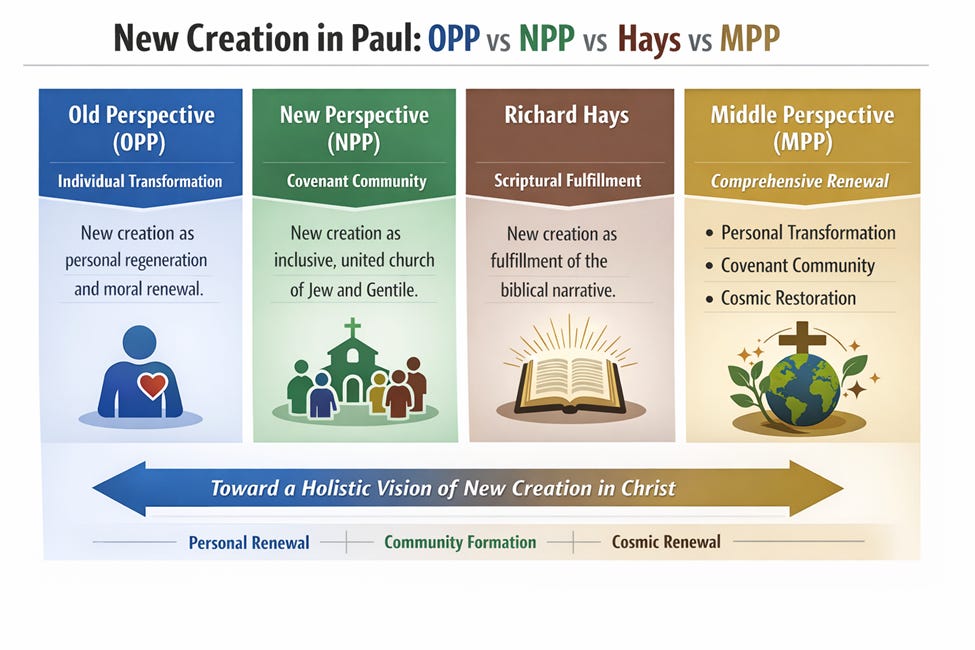
The Old Perspective on Paul (OPP), shaped by the theology of Martin Luther and John Calvin, typically interprets new creation within the framework of individual salvation. In this approach, the central problem addressed by Paul is the guilt of the individual sinner before a holy God. Justification by faith resolves this problem by declaring the sinner righteous on the basis of Christ’s work. Within this theological structure, new creation is often understood as the transforming effect of justification, describing the inner renewal that follows God’s declaration of righteousness. Many modern interpreters within this tradition maintain this emphasis. For example, Stephen Westerholm argues that Paul’s theology fundamentally addresses the universal human problem of sin and God’s gracious justification of the sinner.¹ While this interpretation rightly highlights the seriousness of sin and the necessity of divine grace, it tends to interpret Paul’s language of new creation primarily in terms of individual moral or spiritual transformation. Yet Paul’s language often points beyond personal regeneration toward something far more expansive.
The New Perspective on Paul (NPP) shifts attention from individual guilt to the historical context of Paul’s mission and the relationship between Jews and Gentiles. Scholars such as E. P. Sanders, James D. G. Dunn, and N. T. Wright argue that Paul’s primary concern was not the problem of legalistic works-righteousness but the question of who belongs to the covenant people of God. According to this interpretation, Paul’s doctrine of justification functions primarily to explain how Gentiles are included among God’s people apart from the works of the law. In this framework, new creation refers primarily to the formation of a new covenant community in which Jews and Gentiles are united in Christ. Thus Paul’s statement that neither circumcision nor uncircumcision counts for anything but only new creation highlights the fact that ethnic boundary markers no longer determine membership in the people of God. This perspective has contributed significantly to the understanding of Paul’s historical context and the communal dimension of salvation.² Yet some versions of the New Perspective risk narrowing Paul’s language of new creation to sociological inclusion, focusing primarily on the redefinition of covenant identity rather than the transformation of creation itself.
A somewhat different approach appears in the work of Richard B. Hays, whose scholarship emphasizes the narrative and scriptural foundations of Paul’s theology. In works such as Echoes of Scripture in the Letters of Paul and The Faith of Jesus Christ, Hays argues that Paul’s theological imagination is deeply shaped by Israel’s Scriptures.³ Paul frequently echoes Old Testament texts and themes, interpreting the events of Christ’s death and resurrection as the climax of the biblical narrative. Within this framework, Paul’s language of new creation resonates strongly with prophetic promises such as Isaiah 65:17, where God announces the creation of “new heavens and a new earth.” For Hays, the resurrection of Christ represents the eschatological turning point in the biblical story, the moment when the restoration anticipated in the Scriptures begins to unfold. Hays therefore moves beyond purely individual or sociological interpretations by situating Paul’s theology within the broader narrative of creation, covenant, exile, and restoration. At the same time, his approach sometimes emphasizes narrative intertextuality more strongly than the apocalyptic and cosmic dimensions that many interpreters see in Paul’s theology.
These various interpretations reveal that Paul’s concept of new creation cannot easily be confined to a single theological category. A Middle Perspective on Paul (MPP) offers a way of integrating the insights of these approaches while avoiding their limitations. From this perspective, Paul’s language of new creation encompasses three inseparable dimensions.
First, it involves personal transformation, since believers participate in Christ’s death and resurrection. Paul describes believers as crucified with Christ (Gal 2:20) and raised to walk in newness of life (Rom 6:4). Salvation therefore entails a profound reorientation of human existence.
Second, new creation entails the formation of a renewed covenant community in which ethnic and social divisions are overcome. Galatians 3:28 declares that in Christ there is neither Jew nor Greek, slave nor free, male nor female, because all are one in the Messiah.
Third, and most fundamentally, new creation points toward the cosmic renewal of creation itself. In Romans 8:21 Paul proclaims that creation will be set free from its bondage to decay and share in the freedom of the children of God. This language indicates that the resurrection of Christ inaugurates the restoration not merely of individuals or communities but of the entire created order.
Seen from this broader perspective, the theme of new creation exposes the limitations of both the Old and New Perspectives on Paul. The Old Perspective tends to focus on the transformation of the individual believer, while the New Perspective emphasizes the reconstitution of the covenant community. Both insights are important but incomplete. Paul’s vision ultimately extends beyond both frameworks. The resurrection of Christ inaugurates the renewal of humanity, the formation of a new covenant people, and the liberation of creation itself. New creation therefore represents not merely a doctrinal concept but the beginning of God’s restoration of the world.
Footnotes
Stephen Westerholm, Perspectives Old and New on Paul: The “Lutheran” Paul and His Critics (Grand Rapids: Eerdmans, 2004), 43–60.
E. P. Sanders, Paul, the Law, and the Jewish People (Philadelphia: Fortress Press, 1983), 312–320; James D. G. Dunn, The Theology of Paul the Apostle (Grand Rapids: Eerdmans, 1998), 354–360; N. T. Wright, Paul and the Faithfulness of God (Minneapolis: Fortress Press, 2013), 737–745.
Richard B. Hays, Echoes of Scripture in the Letters of Paul (New Haven: Yale University Press, 1989), 29–33, 320–345; Richard B. Hays, The Faith of Jesus Christ: The Narrative Substructure of Galatians 3:1–4:11, 2nd ed. (Grand Rapids: Eerdmans, 2002), 109–120.
Bibliography
Dunn, James D. G. The Theology of Paul the Apostle. Grand Rapids: Eerdmans, 1998.
Hays, Richard B. Echoes of Scripture in the Letters of Paul. New Haven: Yale University Press, 1989.
Hays, Richard B. The Faith of Jesus Christ: The Narrative Substructure of Galatians 3:1–4:11. 2nd ed. Grand Rapids: Eerdmans, 2002.
Sanders, E. P. Paul, the Law, and the Jewish People. Philadelphia: Fortress Press, 1983.
Westerholm, Stephen. Perspectives Old and New on Paul: The “Lutheran” Paul and His Critics. Grand Rapids: Eerdmans, 2004.
Wright, N. T. Paul and the Faithfulness of God. Minneapolis: Fortress Press, 2013.
Appendix:
References:
1. Hays, Richard B. Echoes of Scripture in the Letters of Paul. New Haven: Yale University Press, 1989.
2. Hays, Richard B. The Faith of Jesus Christ: The Narrative Substructure of Galatians 3:1–4:11. Grand Rapids: Eerdmans, 2002.
3. Sanders, E. P. Paul, the Law, and the Jewish People. Philadelphia: Fortress Press, 1983.
4. Westerholm, Stephen. Perspectives Old and New on Paul: The “Lutheran” Paul and His Critics. Grand Rapids: Eerdmans, 2004.
5. Wright, N. T. Paul and the Faithfulness of God. Minneapolis: Fortress Press, 2013.