He Became Sin:

Rethinking 2 Corinthians 5:21 and Righteousness as Participation Beyond Imputation
2 Corinthians 5:21 stands as one of Paul’s most densely packed theological statements: “For our sake he made him to be sin who knew no sin, so that in him we might become the righteousness of God.” Traditionally, this verse has been read within a forensic and substitutionary framework, where Christ is said to bear sin in a legal sense and believers receive his righteousness through imputation. However, when situated within the immediate literary context of 2 Corinthians 5:14–21 and examined through Paul’s participatory language, the verse yields a different emphasis—one centered not merely on legal exchange, but on transformative participation in Christ and incorporation into God’s reconciling work.[^1]
The immediate context is decisive. Paul frames his argument around reconciliation: “All this is from God, who through Christ reconciled us to himself and gave us the ministry of reconciliation” (2 Cor 5:18), and again, “God was in Christ reconciling the world to himself, not counting their trespasses against them” (5:19). The emphasis is unmistakably relational and dynamic. Reconciliation is not described as a prior satisfaction of divine wrath, but as God’s active initiative to restore relationship. This culminates in the declaration that believers are “ambassadors for Christ” (5:20), indicating not merely a change in status but participation in an ongoing mission. Thus, verse 21 must be read as the theological grounding of this reconciliatory and participatory reality, not as an isolated doctrinal formula.
The Greek expression in 2 Corinthians 5:21 is crucial: ton mē gnonta hamartian hyper hēmōn hamartian epoiēsen. The phrase “he made him sin” (hamartian epoiēsen) has often been interpreted in a strictly substitutionary sense, as if Christ were legally treated as sin itself. However, hamartia in Pauline usage can denote not only sin as guilt but also sin as a power or condition (cf. Rom 5:12–21; 6:6–11). The verb poieō (“to make”) does not necessarily imply ontological transformation or legal imputation alone; rather, it can signify being placed into a role or condition within a redemptive framework. Thus, the phrase is better understood as Christ entering fully into the domain of sin and its consequences, not becoming sinful, but taking upon himself the full reality of the fallen human condition.[^2]
This reading is reinforced by the parallel clause: “so that in him we might become the righteousness of God” (hina hēmeis genometha dikaiosynē theou en autō). The verb genometha (“become”) is transformative, not merely declarative. Paul does not say “that we might be declared righteous,” but that we might become the righteousness of God. Moreover, the phrase “in him” (en autō) is central to Paul’s participatory theology, indicating union with Christ rather than external attribution. Thus, the structure of the verse is not a simple exchange (our sin → Christ; Christ’s righteousness → us), but a movement of incorporation: Christ enters into the condition of sin so that believers might enter into the reality of God’s righteousness through union with him.[^3]
What Did Christ’s Death Actually Do? Sin, Death, and Transformation
The question must again be asked: What does “he became sin” actually accomplish in relation to Sin and Death? In Paul’s theology, sin is not merely a legal problem but a dominating power. In entering into death, Christ enters into the realm where sin exercises its rule. As Paul writes elsewhere, “Christ died to sin once for all” (Rom 6:10), and “God condemned sin in the flesh” (Rom 8:3). Thus, “becoming sin” can be understood as Christ’s identification with the sphere of sin and death, in order to overcome it from within.
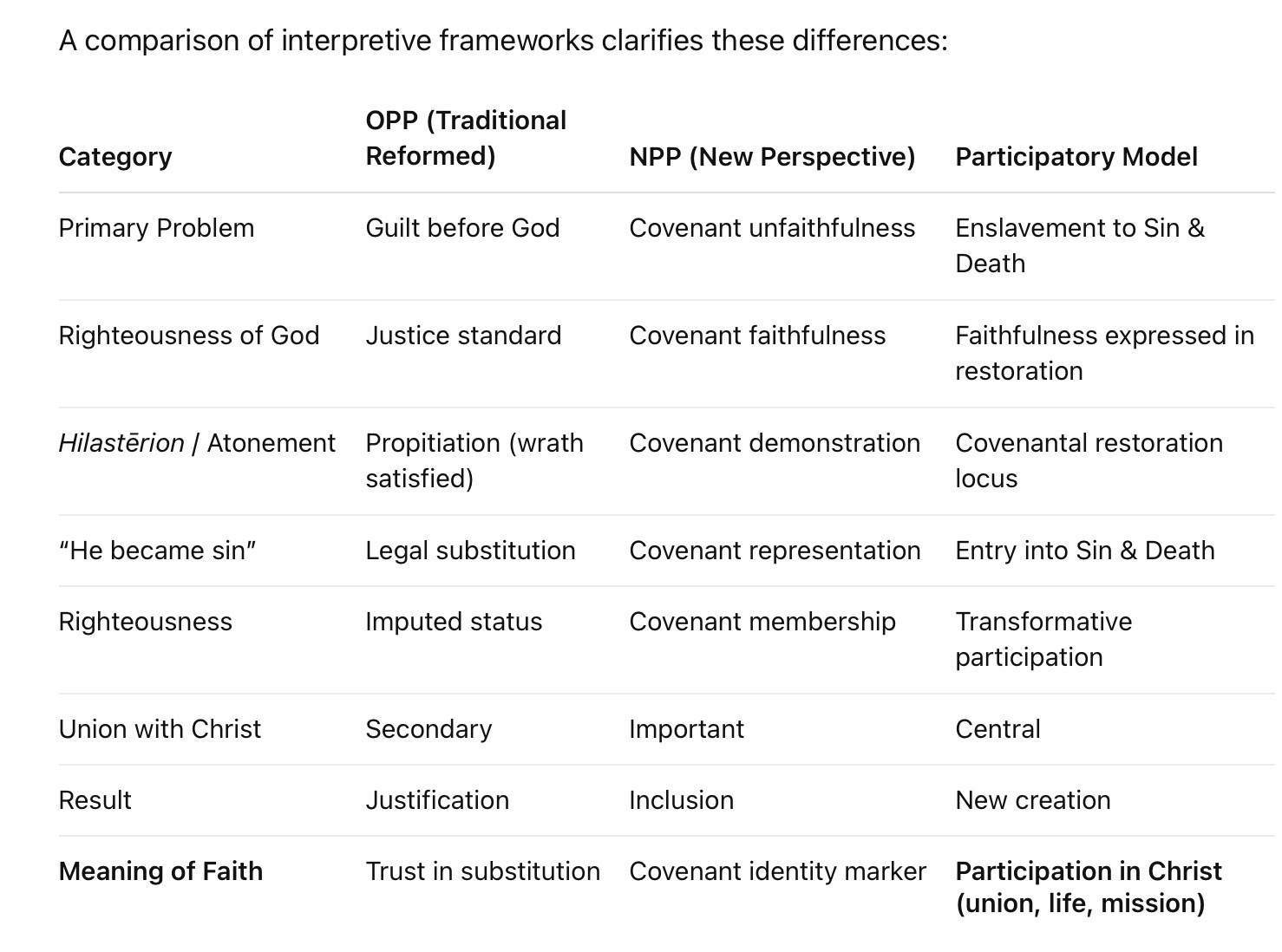
The traditional OPP reading interprets this as penal substitution and imputation: Christ bears the penalty of sin, and his righteousness is credited to believers.[^4] The NPP shifts the focus toward covenant representation and reconciliation, emphasizing communal inclusion. A participatory model, however, sees Christ’s death as the decisive moment where the old humanity under sin is brought to an end, and a new humanity is inaugurated. Believers participate in this reality through union with Christ, becoming part of a new creation (2 Cor. 5:17).
Immediate Context: Reconciliation and New Creation
The broader context confirms this participatory reading. Paul declares, “if anyone is in Christ, he is a new creation” (2 Cor 5:17). This is not forensic language but ontological and participatory transformation. The reconciliation described in verses 18–20 leads directly into verse 21, showing that Christ’s “becoming sin” is the means by which new creation is inaugurated. The emphasis is not on a legal transaction but on a new mode of existence.
Pauline Coherence: Connection with Romans
When read alongside Romans, this interpretation gains further strength. In Romans 6:3–5, believers are “baptized into Christ’s death” and “united with him.” In Romans 8:3, God condemns sin “in the flesh,” paralleling the idea that Christ enters into and overcomes the realm of sin. Thus, 2 Corinthians 5:21 and Romans together present a consistent picture: Christ deals with sin not merely by bearing its penalty, but by defeating its power and incorporating believers into new life.
A Critical Rebuttal: Imputation and Greek Conceptual Influence
A significant concern with the traditional imputation reading is that it can reflect categories more aligned with Greco-Roman legal abstraction than with Paul’s participatory and covenantal framework. The idea of righteousness as a transferable moral substance risks detaching Paul’s language from its relational and narrative context. In 2 Corinthians 5, righteousness is not something possessed externally but something embodied within a reconciled community participating in God’s mission. The emphasis on “becoming” (genometha) and “in Christ” resists purely forensic interpretation. As Paul states, “God was in Christ reconciling the world to himself” (5:19), emphasizing divine initiative and relational restoration rather than legal transfer. Thus, the imputation model, while attempting to safeguard justification, risks imposing a framework that does not fully account for Paul’s emphasis on participation, transformation, and new creation.[^5]
What Does It (then) Mean to Believe in Christ? Faith as Participation
Within this context, the meaning of “believing in Christ” must be carefully defined. In many traditional readings, faith is understood primarily as trust in the substitutionary work of Christ, whereby the believer receives the benefits of his death, particularly the imputation of righteousness. While this captures an important dimension, it risks reducing faith to intellectual assent or reliance upon a completed transaction. In 2 Corinthians 5, however, faith is embedded within a broader participatory and reconciliatory framework. To “believe in Christ” is to enter into the reality of reconciliation that God has accomplished in him, to be incorporated “in Christ” (2 Cor 5:17), and to live as part of the new creation that has been inaugurated. Faith, therefore, is not merely reception but participation: it is the means by which individuals are united with Christ in his death and life, becoming agents of reconciliation (“ambassadors for Christ,” 5:20). This aligns with Paul’s wider theology, where faith involves dying and rising with Christ (cf. Rom 6:3–5) and living in the sphere of the Spirit (Rom 8:9–11). Thus, believing is not simply “accepting” what Christ has done; it is entering into and embodying that reality, sharing in his life, mission, and righteousness. Faith is therefore relational, transformative, and participatory—it is the mode of existence of those who live “in Christ.”[^6]
Conclusion
2 Corinthians 5:21, when read in its immediate context and in light of Paul’s broader theology, points beyond imputation to participation. Christ “becomes sin” by entering into the domain of Sin and Death, and believers “become the righteousness of God” by participating in his life through union with him. This reading preserves the seriousness of sin while situating atonement within God’s larger purpose: reconciliation, transformation, and new creation.
References
[^1]: N. T. Wright, The Day the Revolution Began (2016).
[^2]: James D. G. Dunn, The Theology of Paul the Apostle (1998).
[^3]: Michael J. Gorman, Inhabiting the Cruciform God (2009).
[^4]: John Murray, Redemption Accomplished and Applied (1955).
[^5]: Richard B. Hays, The Moral Vision of the New Testament (1996).
[^6]: Michael J. Gorman, Apostle of the Crucified Lord (Eerdmans, 2004), 204–230; Teresa Morgan, Roman Faith and Christian Faith (Oxford, 2015).